
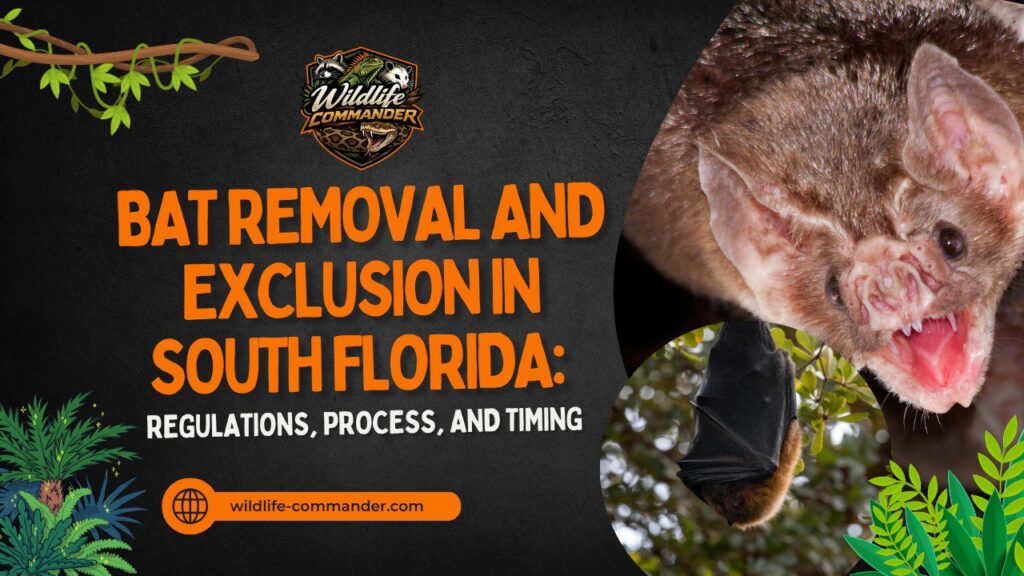
Bat removal in South Florida operates under a more complex regulatory framework than almost any other wildlife species encountered in residential or commercial settings. Two factors set this apart from a standard nuisance wildlife situation: the presence of the Florida bonneted bat, a federally endangered species whose range is centred in South Florida, and a statewide maternity exclusion window that prohibits the sealing of bat entry points between April 15 and August 15.
These are not technical footnotes. They are the determinative factors in how, when, and whether bat work can proceed on any given property. A property owner who hires an operator unfamiliar with these rules — or who attempts to address a bat colony without this knowledge — risks sealing animals inside a structure, violating federal endangered species law, or both.
This guide sets out what property owners, HOA managers, and commercial facility operators in South Florida need to understand before any bat work begins.
Why Bats Are a Special Case in Florida
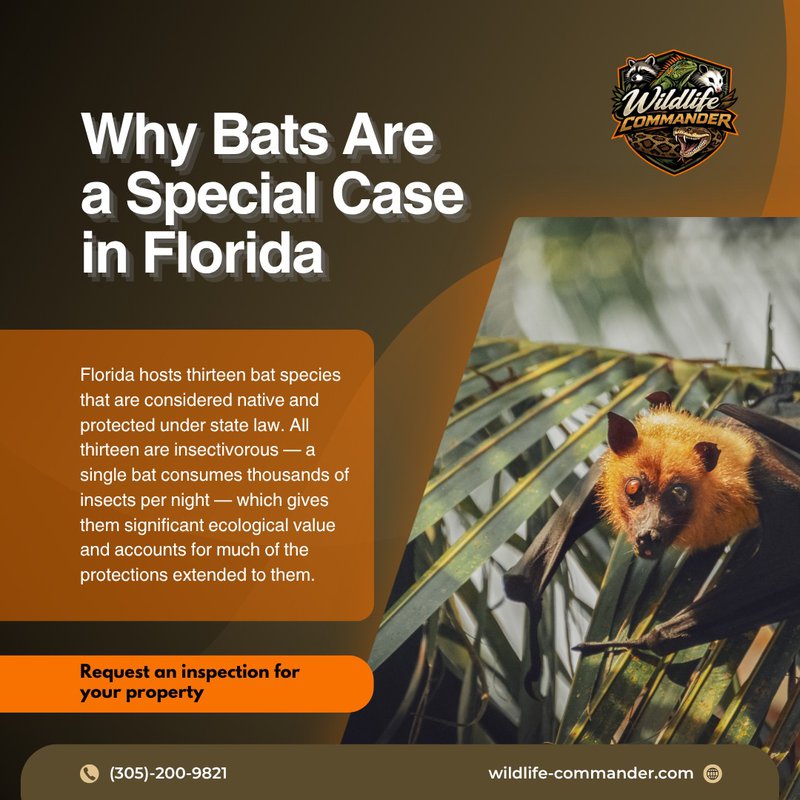
Florida hosts thirteen bat species that are considered native and protected under state law. All thirteen are insectivorous — a single bat consumes thousands of insects per night — which gives them significant ecological value and accounts for much of the protections extended to them. No native bat species in Florida may be harmed, killed, or possessed without a specific FWC permit.
The Florida bonneted bat (Eumops floridanus) takes this further. It is listed as a federally endangered species under the Endangered Species Act, with its known range centred in South Florida — primarily Miami-Dade, Broward, and Collier Counties, with records from Monroe County. Any work that risks harming bonneted bats, disturbing a roosting colony during the maternity period, or destroying roost sites triggers federal compliance requirements that extend beyond standard FWC rules.
Responsible bat work in South Florida begins with the question: what species are present?
Identifying Bat Activity in a Structure
Most property owners do not see bats directly — they identify an infestation through secondary indicators. Common signs of bat colony activity include:
Audible indicators:
- High-pitched chattering or scratching sounds from within walls, attic spaces, or soffits — most audible in the evening as bats prepare to leave the roost, and in the early morning as they return
- Squeaking sounds from void spaces, particularly during periods of elevated temperature when interior roost areas become uncomfortable
Visual and physical indicators:
- Staining at entry points — a rust-brown to black discolouration around gaps in the roofline, soffit joints, or tile edges caused by the accumulation of body oils and guano from animals passing through repeatedly
- Guano accumulation below the roost entry or on exterior walls beneath gap openings; bat guano is dark brown to black, dry, and granular, crumbling easily when touched (distinguishing it from rodent droppings, which tend to have pointed ends and a firmer consistency)
- A strong, persistent ammonia odour rising from the attic or void space where the colony roosts, particularly noticeable in summer heat
Evening observation:
The most reliable field method for confirming a bat colony and estimating its size is dusk observation. Bats emerge from their roost in the early evening, typically within twenty to thirty minutes of sunset. Watching the roofline from a position that allows visibility of the suspected entry area will reveal the size of the exit flight and the location of the primary entry point.
The Florida Bonneted Bat: What Property Owners Need to Know

The Florida bonneted bat is the largest bat species in Florida, with a wingspan reaching approximately thirteen inches. Its vocalizations are audible to some people without instruments, and it roosts in natural cavities, tree hollows, and — increasingly — buildings. Its range overlaps directly with the highest-density residential and commercial development corridors in South Florida.
The practical implication for property owners in Miami-Dade, Broward, and adjacent counties is straightforward: any bat colony discovered in a structure in these counties may include Florida bonneted bats, and must be assessed with that possibility in mind. An operator who does not address this possibility is not operating safely or legally.
FWC and the US Fish and Wildlife Service (USFWS) have produced guidance on bonneted bat roost site management. In practice, this means that any exclusion work in the species' range requires pre-exclusion assessment by a qualified operator and documentation that the exclusion was conducted in compliance with timing and method requirements.
The Maternity Exclusion Window: April 15 to August 15
The maternity exclusion window is the single most important timing consideration in bat work in Florida.
From April 15 through August 15, bat exclusion — the sealing of entry and exit points to prevent bats from re-entering a structure — is prohibited in Florida. The reason is straightforward: this is the period when female bats are raising pups. Young bats are not capable of flight during the early weeks of their lives. If exclusion devices are installed and entry points sealed while pups are present, the pups are trapped inside and will die. Adults are excluded but cannot return to care for the young. The result is a significant mortality event inside the structure, the subsequent odour and public health complications that accompany it, and a likely violation of state and federal wildlife law.
What this means in practical terms:
Properties that discover bat activity during the exclusion window have limited options. The colony cannot be evicted during this period. What can be done during the window includes: full inspection and documentation, monitoring to establish colony size and species, guano assessment, and planning the exclusion work to begin immediately when the window closes on August 15.
Properties that discover bat activity outside the window — August 16 through April 14 — have the opportunity to proceed with exclusion, subject to proper technique.
The August 15 deadline creates a decision point. Property owners with known bat colonies should schedule an inspection before the window opens on April 15. An inspection completed in late winter or early spring establishes the scope of work and allows an exclusion to be booked at the correct time — either before April 15 (if time permits and the colony size allows) or for immediate execution starting August 16.
This is not urgency theatre. It is a genuine planning consideration with a fixed regulatory deadline.
The Bat Exclusion Process
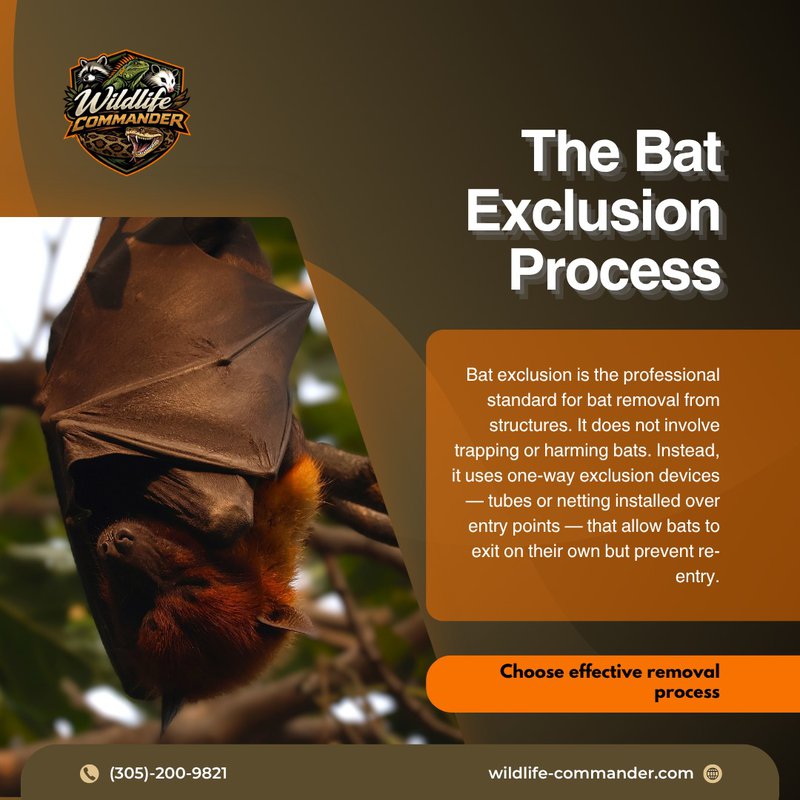
Bat exclusion is the professional standard for bat removal from structures. It does not involve trapping or harming bats. Instead, it uses one-way exclusion devices — tubes or netting installed over entry points — that allow bats to exit on their own but prevent re-entry. Once the colony has vacated, the devices are removed and the entry points are permanently sealed.
The process in sequence:
Step 1: Inspection
A thorough inspection identifies all entry points (primary and secondary), assesses the extent of the colony, identifies guano accumulation areas, and determines whether Florida bonneted bat presence is a meaningful possibility given the property location and roost characteristics.
Step 2: Pre-exclusion guano assessment
Guano accumulation in attic spaces or void spaces should be assessed before exclusion begins. In significant accumulations, guano supports the growth of Histoplasma capsulatum, the fungal organism responsible for histoplasmosis. Disturbing accumulated guano without appropriate containment during exclusion work is a public health risk. In many cases, guano remediation is incorporated into or follows the exclusion.
Step 3: Exclusion device installation
One-way devices are installed at all identified entry points. The exclusion period must be sufficient — typically five to ten days, depending on colony size and weather — to allow the full colony to exit before devices are removed and points are sealed.
Step 4: Permanent sealing
All entry and exit points are sealed using appropriate materials: caulk, hardware cloth, or structural repair as the gap size and location requires. This is where most DIY attempts fail: a properly sealed bat entry point accounts for the full gap perimeter, not just the visible opening.
Step 5: Post-exclusion inspection
A follow-up inspection confirms that no animals remain in the structure and that all points are properly sealed.
Step 6: Guano remediation (if required)
Where guano accumulation is significant, remediation involves safe removal under containment, antifungal treatment of affected surfaces, and in some cases, full insulation replacement where contamination extends through the insulation layer.
Commercial and HOA Considerations

Bat colonies are a common feature of larger structures in South Florida — older commercial buildings, multi-storey residential buildings, and covered parking structures with gaps at expansion joints or under parapet walls. Marina and waterfront commercial buildings, which frequently have open eave or soffit construction, are particularly susceptible.
For HOA and property management:
A bat colony in a common-area structure — a clubhouse roof, a covered amenity area, or a parking structure — is a property management issue as much as a wildlife issue. Guano accumulation on common walkways creates both a public health concern and a slip hazard. Odour from a large colony in a rooftop void is noticed by residents and guests. The maternity window means that failing to act outside the window closes the available removal period for four months.
For commercial buildings:
Larger structures often support multiple smaller colonies rather than a single large roost. Comprehensive exclusion of a multi-storey commercial building requires systematic entry-point identification across the full building envelope — a scope of work that requires aerial access equipment and a methodical approach, not a single-point fix.
Warranty and annual inspection programmes:
Unlike many nuisance wildlife species, bats present a long-term management situation. Once a structure has hosted a colony, it has demonstrated that it provides suitable roost conditions. An annual inspection programme — confirming that all sealed points remain intact and that no new entry points have developed — is the most cost-effective approach to preventing recurrence.
Frequently Asked Questions
Is it legal to remove bats from my house in Florida?
You cannot harm, kill, or trap bats. What is legal — and the correct approach — is exclusion: installing one-way devices that allow bats to leave but not return, then permanently sealing entry points. This must be done outside the maternity exclusion window (April 15 – August 15) and must comply with FWC regulations. A licensed Florida Wildlife Control Officer manages all regulatory compliance.
When is the bat exclusion window in Florida?
The maternity exclusion window, during which bat exclusion is prohibited, runs from April 15 to August 15. Exclusion work can be conducted from August 16 through April 14 of the following year.
What is the Florida bonneted bat and why does it matter?
The Florida bonneted bat is a federally endangered species whose range is centred in South Florida. Its presence in or near a structure under assessment adds federal Endangered Species Act compliance requirements to the work. Any licensed operator conducting bat work in Miami-Dade, Broward, or adjacent counties should assess bonneted bat risk as part of the initial inspection.
Do bats carry rabies in Florida?
Bats are classified as a rabies vector species in Florida. The incidence of rabies in wild bat populations is low — typically less than one percent of tested animals — but exposure risk exists if a bat is handled or if a person wakes to find a bat in a sleeping area. Any direct contact or potential exposure should be reported to your county health department, and the animal should not be killed before it can be tested if possible. A bat found inside a living space warrants medical consultation.
What does bat guano smell like?
Accumulated bat guano produces a strong ammonia-like odour — similar to a concentrated animal urine smell — that is often described as musty, pungent, or acrid. In attic spaces, the smell may be noticeable from below through ceiling fixtures, HVAC vents, or in rooms directly below the roost.
How much does bat exclusion cost in South Florida?
Cost depends on the size of the colony, the number of entry points requiring exclusion, the accessibility of the structure, and whether guano remediation is required. A thorough inspection is the only reliable basis for an accurate estimate. Blanket pricing for bat work without inspection is a red flag — it almost always indicates that the operator is quoting before they understand the scope.
Can I seal bat entry points myself?
Sealing bat entry points without professional assessment carries two significant risks: sealing animals inside the structure (illegal and results in mortality and odour complications), and doing so during the maternity window (illegal). Beyond compliance, amateur sealing work almost always misses secondary entry points, resulting in rapid re-entry.
Acting Before the Window Closes
Property owners and facility managers in South Florida who are aware of bat activity — or who have not assessed a structure that has hosted a colony before — are best positioned if they act now, outside the exclusion window.
An inspection before April 15 establishes what is there, what species are present, how large the colony is, and what a compliant exclusion will involve. That information is the basis for a decision made with time available, not in response to a crisis.
Wildlife Commander conducts bat inspections and provides compliant exclusion services across Miami-Dade, Broward, Palm Beach, and Monroe Counties. Our process accounts for Florida bonneted bat risk assessment, exclusion window compliance, and guano remediation where required.
Request a bat inspection for your property — residential, HOA, or commercial — before the exclusion window opens on April 15.
Wildlife Commander provides licensed bat exclusion and wildlife removal services across South Florida. All bat work is conducted in compliance with FWC regulations and federal Endangered Species Act requirements where applicable.
SEO Brief — For Editorial Reference
Target primary keywords: bat removal South Florida, bat exclusion Florida, bats in attic Florida
Secondary keywords: Florida bonneted bat, bat colony removal Miami, bat guano removal Florida, bat exclusion cost Florida
Long-tail targets: when can bats be removed from a house in Florida, bat maternity exclusion window Florida, is it legal to remove bats in Florida, bat removal HOA Florida
AI search intent targets: "Is it legal to remove bats in Florida?", "When is the bat exclusion season in Florida?", "What does bat guano smell like?", "Do bats carry rabies in Florida?", "What is the Florida bonneted bat?"
Internal link recommendations: Homepage, Iguana Removal (authority anchor), Contact/Inspection CTA
External authority links: FWC Bat Management page, USFWS Florida Bonneted Bat species profile
Schema recommendations: FAQPage schema on FAQ section; Article schema with author/date for E-E-A-T signals; LocalBusiness schema on service area footer
Estimated word count: ~2,200 words
Seasonal note: This article has maximum value when published before April 15 to capture pre-maternity-window inspection demand